
Augmenting Professional Development Among the Leadership Group
Leadership Coaching brings a quality improvement-focused, best practice-based methodology that supports organizations fully committed to the professional development of its people and future leadership team.
Introduction
Effective, well-planned talent management approaches are integral to supporting near and longer term organizational success. For most companies, annual performance reviews serve as an important means through which the types of training support needed by employees are determined for the year or years ahead. Such performance reviews offer an opportunity for employee and supervisor to discuss skill development challenges that warrant attention. With professional development needs identified during the course of performance reviews, it is then important for organizations to assist or guide employees toward the most applicable training resource(s) whose learning objectives are best aligned with the employee’s identified skill-building needs.
Succession planning – conducted both formally in documented plans or performed, when no such formal process is in place, in strategic planning discussions at the executive level – is also relevant to integrating Leadership Coaching within an organization. When career advancement pathways are identified for talented individuals in an organization, an imperative exists to offer appropriate training focused on supporting future advancement in accordance with the succession plan in place.
Responses to several key questions help inform talent management strategies as companies scale to meet future organizational and operational demands:
- “As our business grows, who will lead the changes needed to drive this growth, performing in what management roles?”
- “How can we better prepare our leadership team to assume increased or potentially different senior leadership responsibilities?”
- “What is the timeframe for the leadership restructuring needed to implement our organization’s scaling strategy?”
Leadership coaching is a professional consulting service that offers resources and solutions to address organizational development requirements such as those implied by the questions cited above. Coaching is a sound, future-focused investment in the type of training that produces significant impact in developing essential skills among prospective and current organizational leaders.
What are the Components of Work & People Solutions’ “EMCEE” Leadership Development and Coaching Model?
The “EMCEE” leadership coaching model developed by Work & People Solutions integrates easily and seamlessly into an organization’s efforts to manage its talent and provide professional development support.
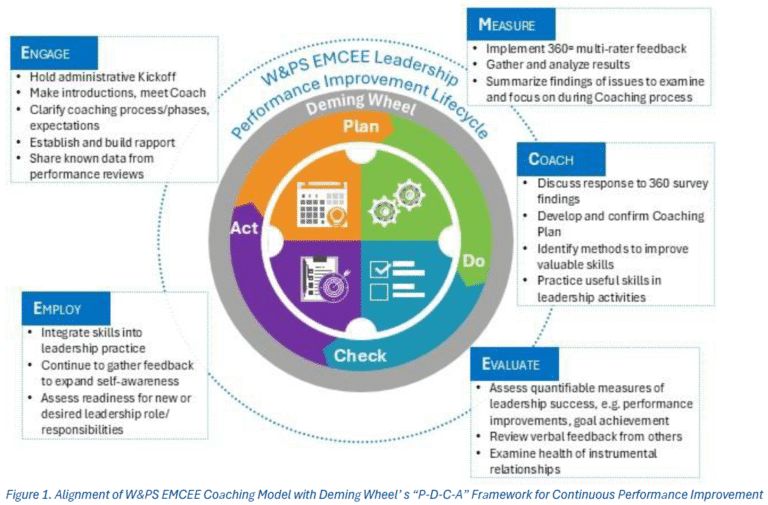
Leadership coaching focuses on improving quality performance of those empowered to guide the organization’s people, processes and technologies. Coaching services integrate well with methods the organization typically applies to assuring quality and continuous performance improvement. As shown below in Figure 1, Work & People Solutions’ EMCEE model aligns its phases with the Deming Wheel’s cornerstone “Plan – Do – Check – Act” (PDCA) lifecycle approach that is the “gold standard” for integrated quality management systems.
The following describes in more depth each of the major phases that comprise Work & People Solutions’ EMCEE leadership coaching lifecycle that fully aligns with the Plan – Do – Check – Act continual service improvement framework.
The following describes in more depth each of the major phases that comprise Work & People Solutions’ EMCEE leadership coaching lifecycle that fully aligns with the Plan – Do – Check – Act continual service improvement framework.
The “Engage” Phase of our lifecycle model is when Planning occurs:
1) With the organization’s HR / Organizational Development team; and then; 2) With those identified to receive supportive coaching services
Engage: Once an organization determines that it wishes to implement Leadership Coaching consulting services from Work & People Solutions, the project is initiated with a Kickoff session held with those responsible at the organization for implementing and championing the Leadership Coaching resource initiative and our consultant Coach or group of Coaches (depending on the scope of the coaching required). This administrative Kickoff serves as an initial engagement step to:
- Share background information on the organization and its objectives for implementing Leadership Coaching support
- Identify resources and bilateral coordination needed to initiate and sustain the Coaching support
- Clarify schedules and timeframes for implementation of various
components of the Coaching lifecycle - Specify what types of information will be shared between W&PS and the organization and how updates will be communicated to ensure effective contract quality oversight and a seamless interface between W&PS, the organization’s HR principals and its coaching clients
After this preliminary, more administratively focused engagement session, a subsequent Kickoff session is scheduled to organize the training project in coordination with those who have been identified to receive the coaching services. In extending invitations to this training program Kickoff session, clarifying the purpose of the program and what will be discussed in this initial meeting is important. The ideal message directed toward prospective coaching clients invited to participate in this specialized training resource is that they have been carefully and strategically selected to participate in a highly tailored professional development program aimed at enhancing leadership competencies across the organization.
Emphasis is placed during the Kickoff session with coaching clients on identifying the program’s primary objectives up front. By offering this resource to its leadership group (and/or prospective leadership team), the organization is demonstrating its willingness to invest in the continuous improvement of professional skills that support the company’s mission-critical management competencies, including its people management aptitudes.
Similarly, the Kickoff session points out that clients’ willingness to participate in this coaching opportunity demonstrates their awareness that improving leadership skills is a continuous learning process. Support and guidance from a professional coaching resource offer a great opportunity to accelerate leadership skill development. To reinforce the professional training focus of the Leadership Coaching program, arrangements can be made for participants to earn Continuing Education credit toward professional certifications such as Project Management Professional (PMP).
The Kickoff agenda facilitates introductions between coaching clients and W&PS Leadership Coaches with whom they will be working and reviews the learner’s participation requirements, the EMCEE coaching model’s iterative processes and timeframes.
After this initial meeting held to introduce coaching recipients and their WP&S Coach, follow-up sessions are planned to begin the coaching relationship. By the end of the Engage phase, the goal is that a healthy and productive interpersonal rapport has begun between coaching client and assigned coach. The Engage phase is complete when Coach and Client have reviewed and agree to move on to the subsequent Measure phase of the project begins (see definition below).
The “Measure” Phase identifies the issues and challenges that will drive development of the Coaching Plan.
Measure: If quality performance improvement is the focus of Leadership Coaching, then the ideal starting point is benchmarking current leadership performance against a set of measures that define leadership effectiveness. This is accomplished through administration of WP&S’s 360 Degree Multi-Rater Survey Tool.
This survey tool enables others with direct exposure to the client’s management/ leadership performance to provide the coaching client with valuable feedback confidentially about their level of agreement with statements about the client’s leadership behaviors. Statements that are rated by those providing feedback are based on management science research and literature that identifies the traits of high performing leaders. In a separate White Paper within this series, we provide a comprehensive description of which leadership competencies are measured by W&PS’s 360 Degree Multi-Rater Survey Tool measures and how the survey is administered efficiently without disruption within the organization.
W&PS gathers and analyzes feedback data from the 360 Degree Multi-Rater Feedback Survey Tool and develops a summary Report of feedback received. This summary is shared with the client once it is complete and available for review and refer back to throughout the coaching process.
The Report summarizes the leadership measures for which the client received the highest average ratings and those for which the client received the lowest average ratings. It looks at variances within the ratings on a specific measure, to assess the extent to which others may observe the applicable management competency consistently or differently. The Report analyzes trends in the higher and lower rated measures, to identify any common threads that can be gleaned from the feedback for use in developing the Coaching Plan.
The “Coach” Phase includes collaborative reviews, discussions, planning and guidance about areas for leadership performance improvement.
Coach: Informed by this summary Report of feedback from the feedback survey conducted among a group of selected co-workers, combined with feedback and recommendations resulting from prior Performance Reviews and Professional Development Plans, the Coach and client collaborate in developing a Coaching Plan that identifies the issues coaching will address and coaching objectives.
The Coaching Plan leverages inputs from the 360 Multi-Rater Feedback Survey and Performance Reviews to clarify training objectives and how achieving these objectives would impact the client’s career plans. The client is encouraged to share their views about the basis for the feedback and potential behavioral improvements that could address the issues raised in the feedback received. Coaches guide these discussions, encourage the gaining of valuable self-awareness through the process, and provide tailored suggestions and recommendations for applying new skills in the client’s day-to-day management practice.
During the Coach phase, as the client is absorbing and then enacting the coaching guidance, a shared awareness grows between the two of them about the client’s leadership practice, circumstances and experiences. Addressing questions such as, “Where do you want to be in the organization in 3-5 years?” helps facilitate discussions of longer-term professional development objectives and the client’s vision of his or her professional future. By reviewing the clients’ long-term professional objectives, the coach can help clients establish a realistic roadmap to achieving their desired future state.
The “Evaluate” Phase assesses evidence from the coaching client’s work environment of the impact shown by applying new or refined skills in day-to-day management practice. Measures can be quantifiable or based on solicited verbal feedback provided to the coaching client.
Evaluate: The Coaching Plan’s documented objectives will include identification of potential measures that enable assessments about whether goals are being attained. Timeframes for assessments of goal attainment are part of the Coaching Plan. Both client and coach maintain a shared understanding about how progress will be evaluated. Ideally, quantifiable evidence of progress being made is identified for evaluation. Such measures are aligned with the leader’s specific role. For example, a business development leader’s performance could include measurement of increases in the new business opportunity pipeline, sales/revenue growth, performance improvements of subordinates such as sales representatives, and customer service reviews.
The client and coach also examine more subjective behavioral changes and their impacts on performance in their respective leadership role. Examples include the value of time management changes made as recommended by the coach to focus on bigger or more urgent priorities; or applying the 80/20 rule as it relates to listening more in team meetings or supervisory exchanges that require a need to better understand circumstances (i.e., through active listening) before having a need to be understood (i.e., when the leader provides direction).
More subjective measurements could also include reviewing team members’ post-meeting feedback about the value and usefulness of meeting discussions. Feedback about enhanced teamwork and improved inter-departmental collaboration is useful. Such feedback is solicited by emotionally intelligent behaviors that increase self-awareness, such as the simple act of asking after a meeting or interaction, “How useful was this session for you?” or “Was this helpful?”
The point is, even if feedback is not provided through a numerical rating on a survey-based satisfaction scale, verbalized feedback can be useful in corroborating that a new skill or leadership technique is proving itself to be effective and useful. It also can support the building of instrumental relationships by showing interest in listening and responding effectively to others – W&PS’ working definition of empathy.
The final phase of the EMCEE model is to Employ proven skills that demonstrate patterns of superior leadership performance.
Employ: Coaching supports the reinforcement of more productive, value-added behaviors that clients need to employ continuously to drive professional success. Coaching also focuses on pointing out any back-tracking into prior behaviors that resulted in the type of less positive feedback that was provided on the multi-rater survey. Making lasting changes requires focus and persistence. Improvement is rarely a linear process. Coaches help support the process of integrating valuable behavioral changes into leadership activities that have proven their worth and effectiveness so that they become more “second nature” in the leader’s daily professional behaviors.
The EMCEE Model for applying Leadership Coaching at your organization provides an multi-phase framework consistent and easily integrated with approaches that drive continuous performance improvement company-wide.