
Building Emotional Intelligence Among the Leadership Team
1:1 Leadership Coaching
offers organizations the means to make a valuable investment in the professional development of their leaders
Introduction
In numerous business case studies and a wealth of publications aimed directly at an audience of senior-level managers or executives within organizations, the instrumental value of developing emotional intelligence (EI) is extolled.1 Some examples include the following:
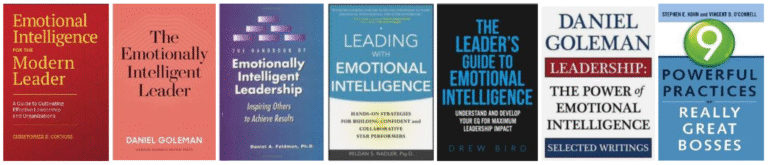
These books and many others like it define what emotional intelligence is and emphasize its intrinsic value when managing others or entire organizations. They explain that increasing one’s EI – also labeled as developing a higher Emotional Quotient, or “EQ” – is far more valuable than relying on more traditional methods of intelligence measurement, particularly Intelligent Quotient (IQ). This White Paper explains the reasons why organizations or individual leaders should engage a leadership coach to support the process of developing emotionally intelligent competencies, i.e., increasing their EQ.
What Specific Skills are Addressed During Leadership Coaching to Support Development of a More Emotionally Intelligent Leadership Style?
Developing one’s EQ for use in performing as an organizational leader is an effort best undertaken with the assistance, input and insights of an external support resource. Certainly, by reading the books cited above one can benefit from gaining an understanding of the instrumental value of EI. But skill development is better and more efficiently achieved with support. Through interactions and guidance of
a specialized professional rather than attempting to apply EI learning on one’s own, EQ improvement occurs more rapidly and is sustained more effectively. The Leadership Coaches from Work & People Solutions are adept at providing the type of guidance and clarification needed to build EI skills.
Footnotes on book references shown above:
1. Christopher D. Connors, Emotional Intelligence for the Modern Leader, Callisto Publishing, 2021; 2. Daniel Goleman, The Emotionally Intelligent Leader, Harvard Business Review Press, 2019; 3. Daniel A. Feldman, PhD, The Handbook of Emotionally Intelligent Leadership: Inspiring Others to Achieve Results, Leadership Performance Solutions, 2019; 4. Reldan S. Nadler, Psy. D., Leading with Emotional Intelligence: Hands-On Strategies for Building Confident and Collaborative Star Performers, McGraw Hill, 2010; 5. Drew Bird, The Leader’s Guide to Emotional Intelligence, Copyrighted Material, 2016; 6. Daniel Goldman, Leadership: The Power of Emotional Intelligence, More Than Sound, LLC, 2011; 7. Stephen E. Kohn and Vincent D. O’Connell, 9 Powerful Practices of Really Great Bosses, Career Press, 2013.

Our Coaches help leadership clients appreciate the value of an other-oriented interactive style – not to be seen as “soft”, but instead to show more connectedness, engagement, inquisitiveness and the art of be emotionally “present”.
Our coaches support EQ development by focusing on highly relevant skills important to supporting improvement of a manager or executive’s leadership skills. These EI-based aptitudes include but are not limited to the following:
Becoming more emotionally self-aware: Coaches support the expansion of leaders’ emotional vocabulary and their ability to identify and manage emotions as they are being experienced. Coaching helps guide the client in the process of connecting to what one is feeling with how that emotion influences leadership-essential behaviors. Emotional self-awareness is a fundamental skill leaders need to maintain and continuously develop in order to increase their EQ.
Confirming personal strengths and acknowledging identified leadership challenges:
In addition to supporting greater emotional self-awareness, coaching assists clients in techniques that promote a valid, evidence-based assessment of their existing leadership competencies and areas where improvement is warranted. An accurate assessment of one’s strengths and challenges facilitates the performance of important leadership capabilities, such as more easily empowering others by delegating tasks, identifying and mitigating risks and enhanced collaboration in a multi-disciplinary setting.
Developing an “other orientation” by practicing empathy and listening actively:
Coaches guide clients to understand the benefits of seeking first to understand others before focusing on being heard and understood by others. The essence of this element of the high performing leader’s “toolbox” is active listening and applying an empathic interactive style. Defined by our coaches as the ability to understand and respond effectively to the experience of others, empathy is a cornerstone leadership skill. It is used to communicate more effectively, “read the room” more readily in group-based environments, build instrumental relationships, motivate staff performance, establish rapport more readily and enhance overall team morale. Our Leadership Coaches help clients by explaining the key features and importance of an empathic interpersonal style but also by modeling empathy for the client during the coaching process.
Gain perspectives more easily about the interests, goals, immediate and longer-term needs of organizational customers: The growth and success of any organization is driven by a customer-centric approach. Our coaches help leaders understand and respond effectively – i.e., demonstrate empathy – to internal and external customers upon whom the organization’s prosperity is contingent.
Applying EI to improve effectiveness of their own coaching and mentoring efforts: A key measure of effectiveness in a leadership role is the extent to which leaders can motivate their teams to higher levels of productivity and customer service. Our coaches focus on building skills that enable leaders to serve in a coaching or mentoring role themselves. Armed with the key EI competencies of self- and other awareness, your leaders will be in an enhanced position to assist in the professional growth and skill development of those being led.
Appreciating the value of managing stress and maintaining work/life balance:
A solid understanding of the causes and symptoms of leadership “burnout” is valuable as a means to help prevent it from occurring. The time demands and energy required to perform consistently well as an organizational leader is enormous. The ability to cope with a variety of omnipresent stressors is essential. Through the supportive feedback and guidance of our Coaches, your leadership clients will develop greater awareness of the triggers that set them up for emotional and physical burnout.

What Outcomes Can the Organization Expect When Leaders Develop a Higher EQ?
The publications cited above all provide many case examples of the benefits to both the individual leader and the organizations they manage by demonstrating more emotionally intelligent behaviors. The numerous value-added benefits to organizations from providing coaching-assisted support in developing their leaders’ EI.
-
-
- Less conflicts; and more timely, productive resolution of conflicts that do arise
- Enhanced agility in responding to impact of emerging factors in business environment, with willingness/increased capability to accept/manage change
- Better teamwork, staff loyalty and morale
- Higher retention of talent within the organization
- More effective mentoring by the leadership team
- Effective modeling for staff about ways to communicate effectively and engage
- others in productive interactions
- Greater customer relationship management
- Less instances of leadership burnout
-

Case Study
A regional subsidiary of a global giant manufacturer in the chemical industry transferred a Plant Manager from one firm location in a different part of the country to a different worksite, primarily to provide a retention-focused promotion opportunity to a talented, emerging “star” performer.
Coaching Helps an Experienced, “Command and Control”-type of Senior Manager Apply Emotional Intelligence Skills to the Challenges of Making the Transition to Supervising a New Business Operation with an In-Place Group of Middle Managers
The operation to which the Plant Manager was transferred produced a different product and had a slightly lower employee base. The transferred Plant Manager, whom this case study will refer to as Jody, replaced a very popular senior leader who chose to retire early.
Sensing that the transition to a new worksite would require Jody to address and overcome a range of challenges, the company engaged a Leadership Coach from Work & People Solutions proactively to assist him in implementing the transition as effectively and efficiently as possible.
Among the foreseeable challenges facing Jody were:
-
-
- Need to develop instrumental relationships rapidly with the plant’s middle- and senior-level staff, all of whom were very loyal to the retiring Plant Manager
- Need to gain a better understanding of the plant’s workflow, supervisory structure and customer base of the plant’s products
- Need to maintain the plant’s financial performance and ideally increase its profitability
- Need to manage the stress caused by the forced relocation of
Jody’s family to the community in New Jersey where the manufacturing site was located. This challenge was exacerbated by Jody having teenage children who resisted the need to move so far away from their existing community in Texas where they had long-term roots, friends and academic success.
-
Despite owning a lengthy and consistent track record of success performing for the company in a Plant Manager role, Jody’s transfer within the organization created some concerns at the corporate level that he might be a bit too strong-handed in his management style. He was accustomed to owning the authority to make decisions independently and having these decisions carried through without much dissent.
While Jody was comfortable with the decision to engage a Leadership Coach to support him in making an effective transition to his new work assignment and geographic location, he deemed the need for the coach as primarily one of assisting with priority setting. He had never received any training or background in the value of EI in improving his leadership capabilities.
The Leadership Coach initiated his support for Jody by listening closely to him discussing the prospect of transitioning into his new role. At one point after this process began, Jody noted jokingly to the Coach, “It seems like I am doing all the talking here!” This observation provided the Coach with an excellent opportunity to discuss the value of seeking first to understand before seeking to be heard by others. The coach noted that this listening skill was an essential and highly important competency for those implementing the types of change that Jody was about to experience. “From this point on in our work together, we will label this skill as ‘practicing empathy’. We will keep coming back to this label to help remind you of its vital importance in the process of transitioning into your new role.”
Within the initial meetings Jody had with his new middle management group, he was attentive to facilitating discussion that enabled him to gain the perspectives and viewpoints of his new colleagues about the plant’s work processes and existing challenges. Fighting the impulse to clarify “that is not how we did these things in Texas”, he practiced the empathy skills modeled by the Leadership Coach. The Leadership Coach encouraged Jody to meet with each middle manager individually to continue this process of seeking to understand their needs and priorities. These meetings served as a valuable starting point in the develop instrumental relationships more rapidly between Jody and his new direct subordinates.
A few weeks after Jody’s transfer to the New Jersey plant, during which he and the Leadership Coach had reviewed the value of identifying emotions and their impact on his leadership behavior, an unusual but significant incident occurred at the plant. Within a division that had experienced several recent staff firings or reductions in force, a popular employee had been terminated the day before. A remaining employee had secretly taken over the loudspeaker system at the plant and provocatively played the Queen song, “Another One Bites the Dust” for all to hear. Some staff laughed at what they perceived as comical acting out by the perpetrator, but many also felt uneasy with its reminder of how the plant was losing co-workers whom they liked and trusted.
When Jody heard this song broadcast over the loudspeaker, his initial reaction was fury at the person who played the song and at the manager of the relevant division where the incident occurred. His initial inclination was to bring the employee and manager to his office and explode in a loud, red-faced rage about the inappropriateness of this behavior, its immaturity and unacceptability. Applying the concepts he was being taught by the Leadership Coach, Jody recognized how deeply livid he was and that this anger might cause unnecessary ramifications. While knowing that this incident needed to be addressed quickly, he also had learned from the coaching he had received that emotional, knee-jerk reactions fueled by his anger could obviate an opportunity to create more lasting change than a simple reprimand would entail.
He called an emergency meeting of his entire middle management group, not simply the manager whose employee was responsible for the acting out behavior. He shared with this group that while he was infuriated by the incident, he was seeking to understand the underlying factors behind the incident’s behavior. Why would a staff member flout or magnify the fact that a person has lost his job here? What message does this send to other staff? What type of reprimand was in order, in their view? Moreover, Jody wanted his managers to share with him how this incident reflected on the current working culture at the plant. What ideas did they have about improving the work culture to become one of more respect, dignity and support?
A healthy discussion among the leadership group ensued, and action plans were set in place. The essence of the after action planning was to communicate to staff that while leadership was unified in their strong disappointment with this type of acting out by employees – and are ready to impose strong sanctions for any similar acting out in the future – leadership wanted to learn more about how staff felt about the underlying causes such as views about the plant’s work culture, employee downsizing actions, and the need for dignified treatment when reductions in force occurred.
A survey was planned and administered through an easy-to-complete rating document that could be completed online at the employees’ convenience. Additionally, group sessions with staff representatives led by division managers would be held to gather more detailed feedback. Findings would be analyzed from this needs assessment and the senior leadership group would respond as appropriate.
In essence, the process was consistent with procedures the plant followed in compliance with national quality management system standards for which the plant had received industry certification. By framing the discussions with staff as a quality management initiative, the plant’s leadership was able to mitigate any concerns that the sessions’ essential goal was to gain more information from staff about similar acting out plans or conspiracies.
Through this incident response, Jody acknowledged in coaching sessions that the skill of seeking first to understand is “not really in my sweet spot.” It is far easier, he acknowledged, to “bring down the hammer” and issue unilateral mandates and directives as a Plant Manager. But he was beginning to see the real value in responding to management challenges through a process of listening more extensively and using that skill to explore circumstances applicable to finding longer-term, lasting positive results.
Coaching Helps an Experienced, “Command and Control”-type of Senior Manager
Apply Emotional Intelligence Skills to the Challenges of Making the Transition to Supervising a New Business Operation with an In-Place Group of Middle Managers
Initial Focus of EI-based Coaching:
Practicing empathy and building instrumental relationships
Implementing EI in Leadership Practice:
– Applying emotional self-awareness
– Seeking first to understand
– Managing feelings to support a more effective, long-term outcome